
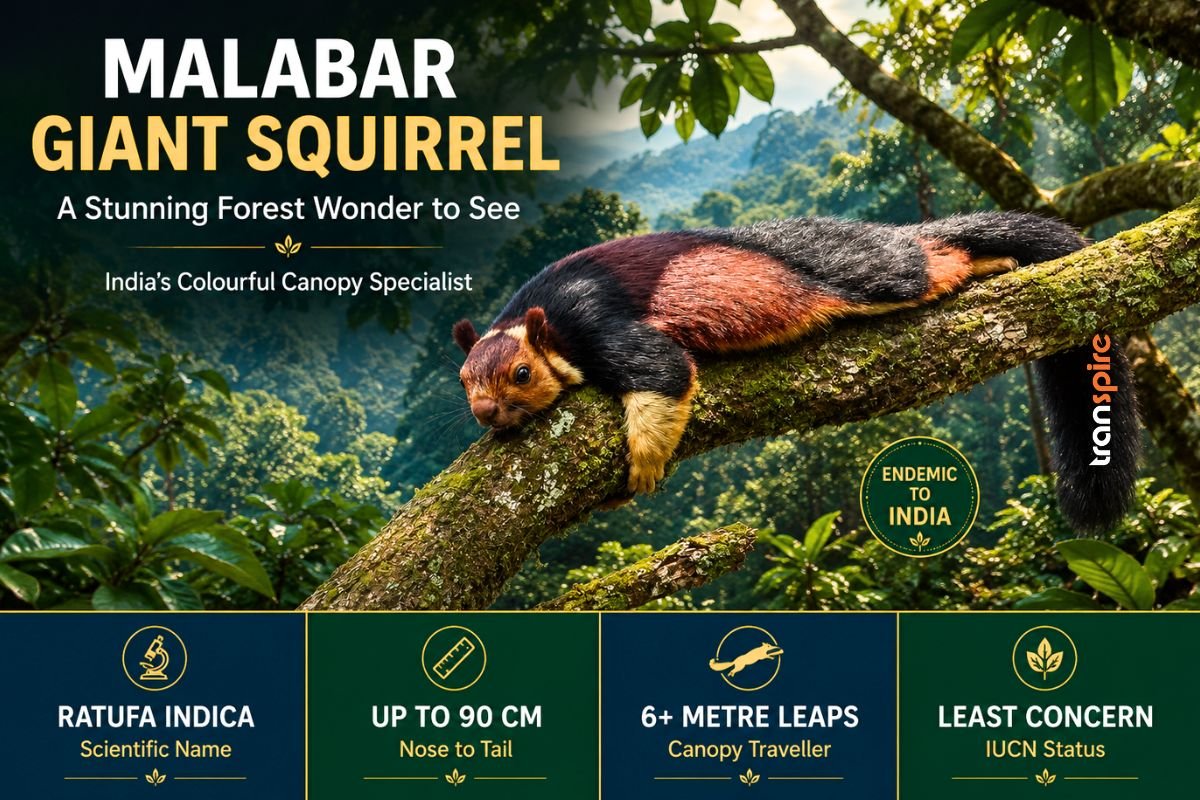
Discover the colourful Indian giant squirrel, its remarkable canopy lifestyle, feeding habits, forest role, and the best wildlife destinations for possible sightings.
The Malabar Giant Squirrel looks almost too colourful to be real. Its coat may feature deep maroon, rust, brown, black, beige, and cream. Moreover, its long bushy tail makes this unusual animal even more striking.
However, spotting one in the wild is not always easy. This squirrel spends most of its life in the upper forest canopy. It feeds, rests, travels, and builds nests without regularly touching the ground.
Also called the Indian giant squirrel, this remarkable species offers more than a memorable wildlife sighting. Its daily routine shows how nature balances movement, rest, and survival.
What Makes the Malabar Giant Squirrel Special?
The Malabar Giant Squirrel, scientifically known as Ratufa indica, is endemic to India. Therefore, it occurs naturally nowhere else in the world.
Its body can measure between 25 and 46 centimetres. Meanwhile, the tail is often almost as long as the body. As a result, a large adult may approach 90 centimetres from nose to tail.
Adults commonly weigh around 1.5 to 2 kilograms. Powerful claws and broad paws also help them move safely through tall trees.
| Feature | Quick fact |
|---|---|
| Scientific name | Ratufa indica |
| Other name | Indian giant squirrel |
| Habitat | Tropical and deciduous forests |
| Lifestyle | Diurnal and arboreal |
| Main food | Fruits, seeds, flowers, leaves and bark |
Adults commonly weigh around 1.5 to 2 kilograms. Powerful claws and broad paws also help them move safely through tall trees.
A Colourful Coat Made for the Canopy
Unlike common urban squirrels, this species does not have a simple grey or brown coat. Instead, its fur may combine several rich colours.
In addition, its cream-coloured underparts and rounded ears give it a distinctive appearance.
Colours That Vary Between Regions
Not every Indian giant squirrel has the same colour pattern. The shades can vary between subspecies and locations.
Consequently, squirrels seen in different parts of India may look surprisingly different.
How Bright Fur Provides Camouflage
Although its coat appears bright, the colours provide useful camouflage. Patches of sunlight, leaves, branches, and shadows break up the animal’s outline.
Therefore, it can remain difficult to see even when resting on an exposed branch.
A Useful Spotting Clue for Travellers
Look for a thick tail hanging below a branch. Often, the large tail is easier to notice than the squirrel’s body.
How the Malabar Giant Squirrel Lives Above the Ground
The Malabar Giant Squirrel is a true canopy specialist. It spends most of its time high above the forest floor.
Moreover, it can leap six metres or more between nearby trees. Its long tail acts as a counterweight during these impressive jumps.
When danger appears, the squirrel may freeze or flatten its body against a branch. Its natural colours then help it blend into the forest.
What Does This Giant Squirrel Eat?
Its diet mainly includes:
- Fruits and berries
- Seeds and nuts
- Flowers and leaves
- Bark and plant stems
- Occasionally insects or bird eggs
Therefore, it is an omnivore with a largely plant-based diet. It usually holds food in its front paws while balancing on a branch.
Rest Is Part of Its Survival Strategy
This colourful squirrel may look lazy while stretched across a branch. However, resting is an important survival behaviour.
Field observations have found that Indian giant squirrels spend similar amounts of time feeding and resting. Their quiet periods help them conserve energy between foraging trips and long canopy leaps.
In other words, they are not simply lazy. Instead, they use their energy carefully.
Multiple Nests in the Treetops
These squirrels build large, rounded nests called dreys. They construct them with leaves, twigs, and small branches.
Furthermore, one squirrel may maintain several nests within its territory. Some provide resting places, while another may serve as a nursery for young squirrels.
Where Can You See the Malabar Giant Squirrel?
The Malabar Giant Squirrel lives across parts of peninsular and central India. Its range includes the Western Ghats, sections of the Eastern Ghats, and central Indian forests.
In Kerala, possible sighting locations include:
- Wayanad Wildlife Sanctuary
- Periyar Tiger Reserve
- Shendurney Wildlife Sanctuary
- Silent Valley National Park
- Dhoni Hills
- Aralam Wildlife Sanctuary
Meanwhile, Bhimashankar Wildlife Sanctuary in Maharashtra is another famous habitat. The animal is locally known as Shekaru and is the state animal of Maharashtra.
It can also occur in suitable forests across Karnataka, Tamil Nadu, Madhya Pradesh, and other parts of its natural range.
How to Improve Your Chances of a Sighting
Follow these simple wildlife-watching tips:
- Visit during the early morning or late afternoon.
- Scan the upper branches slowly.
- Listen for calls and movement among the leaves.
- Carry binoculars or a camera with a zoom lens.
- Join a guided forest walk where available.
Still, remember that wildlife sightings are never guaranteed.
Responsible Wildlife Viewing Tips
A responsible traveller should cause as little disturbance as possible. Therefore:
- Never feed wild squirrels.
- Avoid shouting or playing recorded animal calls.
- Do not shake branches to get photographs.
- Stay on approved forest trails.
- Keep a safe distance from nests.
- Follow instructions from forest officials and guides.
These simple steps protect wildlife while creating a better experience for every visitor.
Why This Canopy Dweller Matters
Indian giant squirrels play an important role in forest ecosystems. As they eat fruits and move between trees, they help disperse seeds.
However, they depend heavily on healthy forests with connected canopies. Habitat loss can separate feeding areas, nesting trees, and safe travel routes.
The species is currently classified as Least Concern by the IUCN. Nevertheless, deforestation and forest fragmentation remain important conservation concerns.
Protecting the Malabar Giant Squirrel
The Malabar Giant Squirrel is much more than a colourful wildlife attraction. It is an agile canopy traveller, an important seed disperser, and a unique part of India’s natural heritage.
Most importantly, its quiet daily routine offers a simple lesson. Rest is not always wasted time. In nature, slowing down and conserving energy can be essential for survival.
Frequently Asked Questions
Is the Malabar Giant Squirrel Found Only in India?
Yes. Ratufa indica is endemic to India. Its natural range covers suitable forests in peninsular and central parts of the country.
How Large Can an Indian Giant Squirrel Grow?
Its body can reach about 46 centimetres. Including the long tail, a large adult may measure close to 90 centimetres.
Can the Malabar Giant Squirrel Fly?
It cannot fly or glide. However, its powerful legs allow it to leap six metres or more between trees.
What Does the Malabar Giant Squirrel Eat?
It eats fruits, seeds, nuts, flowers, leaves, bark, and plant stems. Occasionally, it may also consume insects or bird eggs.
Is the Indian Giant Squirrel Endangered?
The IUCN currently classifies it as Least Concern. However, habitat destruction and broken forest canopies may affect local populations.