
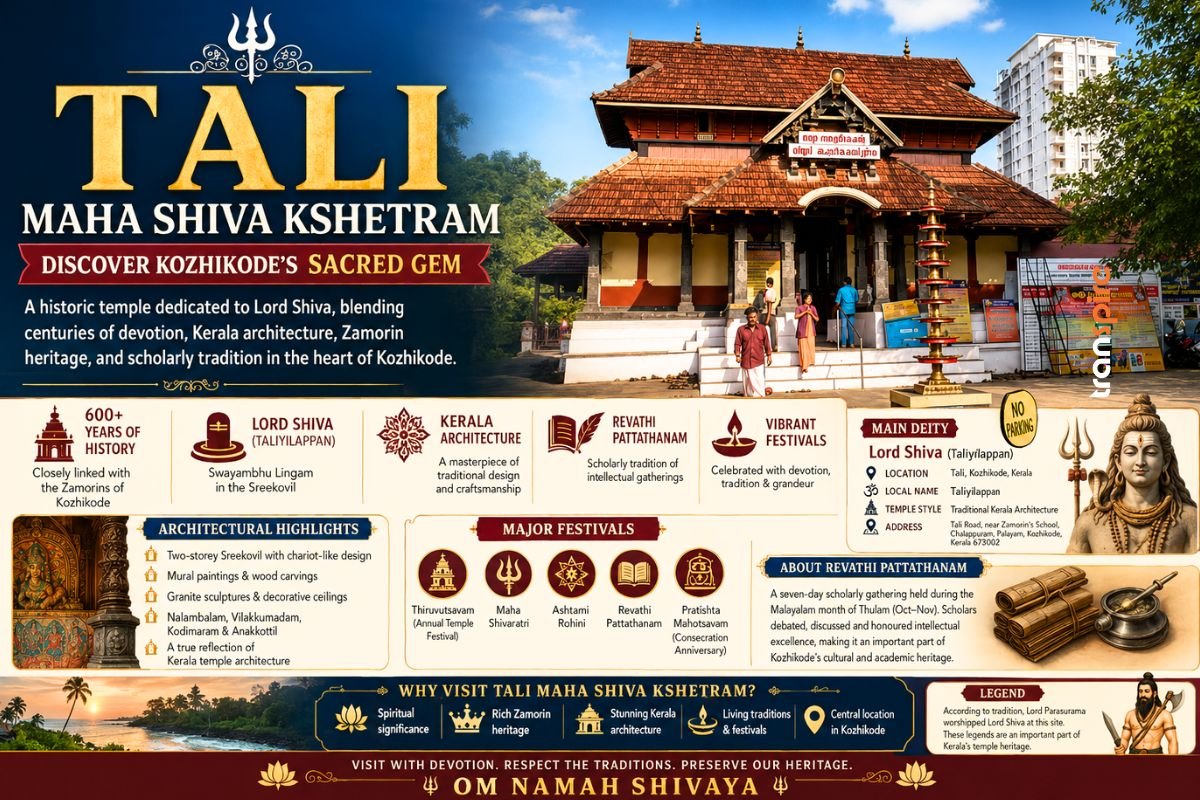
In the busy heart of Kozhikode stands Tali Maha Shiva Kshetram, one of the city’s most important historic temples. Dedicated to Lord Shiva, this sacred site brings together centuries of worship, Kerala architecture, royal history, and scholarly tradition. Therefore, it is much more than a place of prayer. It is also an important heritage landmark for anyone interested in the cultural story of Kozhikode.
The temple is closely connected with the Zamorins, the former rulers of Kozhikode. Moreover, the main temple structure seen today is generally associated with the 14th century. Over the centuries, the temple has survived periods of conflict, restoration, and change while maintaining its spiritual importance.
Tali Maha Shiva Kshetram and Its Main Deity
The principal deity of Tali Maha Shiva Kshetram is Lord Shiva, locally known as Taliyilappan. The Shiva Lingam inside the main sanctum, or Sreekovil, is traditionally worshipped as a Swayambhu, meaning self-manifested.
The Sadasiva Concept
The east-facing Lord Shiva is worshipped here in the Sadasiva concept, together with Parvati, Ganesha, and Subrahmanya. This gives the main shrine special religious significance.
In addition, the temple complex contains shrines associated with several Upadevathas, or subsidiary deities.
Other Deities Worshipped at the Temple
Visitors can find shrines dedicated to:
- Lord Krishna
- Lord Ganesha
- Narasimhamoorthy
- Lord Ayyappa or Sastha
- Bhagavati
- Nagas or serpent deities
Thus, the temple complex reflects the diverse traditions commonly seen in historic Kerala temples.
History of Tali Maha Shiva Kshetram
The history of Tali Maha Shiva Kshetram is closely linked with the rise of Kozhikode as an important political and cultural centre.
Historical accounts state that the temple was initially associated with Nambudiri families of the Tali area. Later, it came under the authority of the Zamorins of Kozhikode. Subsequently, the temple was renovated during the reign of Manavikraman.
Destruction, Restoration and Preservation
Like many historic sites in Malabar, the temple experienced difficult periods. It suffered damage during the Mysorean invasions associated with Hyder Ali and Tipu Sultan. However, the temple was later restored.
Furthermore, another major renovation took place in 1964. These restoration efforts helped preserve the temple for future generations.
Today, its long history makes it an important stop for travellers exploring Kozhikode’s heritage.
Architecture That Reflects Traditional Kerala Design
One of the best reasons to visit Tali Maha Shiva Kshetram is its architecture. The temple showcases traditional Kerala design with detailed craftsmanship and a distinctive visual character.
The Sreekovil
The main Sreekovil has a striking two-storey form often described as resembling a chariot. Meanwhile, its traditional proportions create an impressive focal point within the complex.
Traditional Art and Craftsmanship
The temple is also known for artistic details such as:
- Mural paintings
- Detailed wood carvings
- Granite sculptures
- Decorative ceilings
- Traditional temple structures
Important Features of the Temple Complex
The premises include a spacious Nalambalam, a Vilakkumadam lined with lamps, a Kodimaram or flagstaff, and an Anakkottil.
What Architecture Lovers Should Notice
While visiting, take time to observe the wooden craftsmanship, roof design, stonework, murals, and traditional spatial arrangement. Together, these features provide an excellent introduction to Kerala temple architecture.
Revathi Pattathanam and Kozhikode’s Scholarly Heritage
Revathi Pattathanam is one of the most fascinating traditions associated with Tali Temple and the Zamorin era.
Traditionally, it was a seven-day scholarly gathering held during the Malayalam month of Thulam, which usually falls in October or November. Scholars gathered for intellectual discussions and debates.
Therefore, the event became an important part of Kozhikode’s academic and cultural heritage. Celebrated scholars, including Melpathur Narayana Bhattathiri, are associated with this scholarly tradition.
Revathi Pattathanam shows that the temple historically served not only as a religious centre but also as a place connected with learning and intellectual achievement.
Major Festivals at Tali Maha Shiva Kshetram
Festivals bring a different atmosphere to Tali Maha Shiva Kshetram. Devotees gather in large numbers during important religious occasions.
Some of the major annual observances include:
- Thiruvutsavam – the annual temple festival
- Maha Shivaratri – an important festival dedicated to Lord Shiva
- Ashtami Rohini
- Revathi Pattathanam
- Pratishta Mahotsavam – the consecration anniversary festival
Consequently, visiting during a festival can offer travellers a deeper view of the temple’s living traditions. However, festival periods may also attract larger crowds.
Legend Associated With the Temple
A traditional legend connects the temple with Lord Parasurama. According to local belief, Parasurama worshipped Lord Shiva at this site.
However, this story belongs to the temple’s traditional lore and should not be treated as documented historical evidence. Even so, such legends form an important part of Kerala’s temple culture and oral traditions.
Visiting Tali Maha Shiva Kshetram in Kozhikode
The temple is located in Tali, close to the centre of Kozhikode. Therefore, travellers can easily include it in a wider Kozhikode sightseeing plan.
| Visitor Information | Details |
|---|---|
| Location | Tali, Kozhikode, Kerala |
| Main Deity | Lord Shiva |
| Local Name of Deity | Taliyilappan |
| Temple Style | Traditional Kerala architecture |
| Address | Tali Road, near Zamorin’s School, Chalappuram, Palayam, Kozhikode, Kerala 673002 |
Visitors should dress respectfully and follow the temple’s current entry, photography, and worship rules. In addition, checking current opening hours before travelling is recommended.
Why Tali Maha Shiva Kshetram Is Worth Visiting
Kozhikode is famous for its food, maritime history, markets, and cultural diversity. Yet its historic temples reveal another side of the city.
Tali Maha Shiva Kshetram combines devotion, architecture, Zamorin history, legends, festivals, and centuries-old scholarly traditions within one remarkable heritage site. Moreover, its central location makes it convenient to include in a Kozhikode itinerary.
Whether you visit for worship, history, architecture, or cultural exploration, Tali Maha Shiva Kshetram offers a meaningful glimpse into the living heritage of Kerala.
FAQ – Tali Maha Shiva Kshetram
Where is Tali Maha Shiva Kshetram located?
Tali Maha Shiva Kshetram is located at Tali Road near Zamorin’s School in the Chalappuram–Palayam area of Kozhikode, Kerala.
Who is the main deity of Tali Maha Shiva Kshetram?
The main deity is Lord Shiva, locally known as Taliyilappan. The Shiva Lingam is traditionally worshipped as a Swayambhu or self-manifested Lingam.
Why is Tali Temple historically important?
The temple has strong historical links with the Zamorins of Kozhikode. It is also associated with Revathi Pattathanam, an important scholarly tradition of the Zamorin era.
What is special about the architecture of Tali Temple?
The temple displays traditional Kerala architecture. Its notable features include a distinctive Sreekovil, wood carvings, murals, granite sculptures, decorative ceilings, Nalambalam, Vilakkumadam, and Kodimaram.
What are the major festivals celebrated at Tali Temple?
Important observances include Thiruvutsavam, Maha Shivaratri, Ashtami Rohini, Revathi Pattathanam, and Pratishta Mahotsavam.
What is Revathi Pattathanam?
Revathi Pattathanam is a historic scholarly tradition associated with Tali Temple and the Zamorin period. It traditionally involved several days of intellectual discussions, debates, and recognition of distinguished scholars.